

Plantation Shutters vs. Blackout Blinds: Privacy, Light Control, And Heat In Las Vegas
When comparing plantation shutters vs. blackout blinds, the short answer is this — shutters are usually better for adjustable daylight, flexible privacy, and long-term everyday use, while blackout products are usually better when the room needs to be as dark as possible. At Best Buy Shutters Las Vegas, we help homeowners compare these options based on how they actually use each room, especially when light control, privacy, and protection from the Las Vegas sun are priorities.
In most cases, the term “blackout blinds” refers to blackout shades, usually roller or cellular shades that are made with opaque room-darkening material rather than traditional slatted blinds.
That distinction matters in Las Vegas. The National Weather Service reports a normal July average high of 104.5°F, so harsh sun, afternoon glare, and heat gain shape window treatment decisions in a real way.
Shutters can darken a room very well, but they are not typically true blackout. A properly fitted blackout shade is the stronger choice when sleep, naps, or screen visibility comes first.
Plantation Shutters vs. Blackout Blinds At A Glance
| Feature | Plantation Shutters | Blackout Shades |
| Daytime privacy | Excellent and adjustable | Excellent when fully lowered |
| Nighttime privacy | Excellent when fully closed | Excellent when fully lowered |
| Maximum darkness | Very good, but not usually total blackout | Best option when properly fitted |
| Adjustable daylight | Excellent | Limited, unless raised or partially lowered |
| Heat and glare control | Strong when closed or angled | Strong when closed; depends on fabric and fit |
| View outside | Adjustable through louvers | Usually blocked when lowered |
| Style | Architectural and built-in | Clean, minimal, fabric-based |
| Durability | Typically, very durable | Varies by fabric and operating system |
| Cleaning | Easy to wipe, but many louvers | Usually simple, though fabric can hold dust |
| Best rooms | Living rooms, kitchens, offices, street-facing rooms | Bedrooms, nurseries, guest rooms, media rooms |
| Motorization | Available in some setups | Commonly available |
| Upfront investment | Generally higher | Often lower, depending on material and controls |
What Is The Main Difference Between Plantation Shutters And Blackout Shades?
Plantation shutters use framed panels with adjustable louvers. You can tilt those louvers slightly, halfway, or fully shut, which gives you gradual control over sun, glare, privacy, and view.
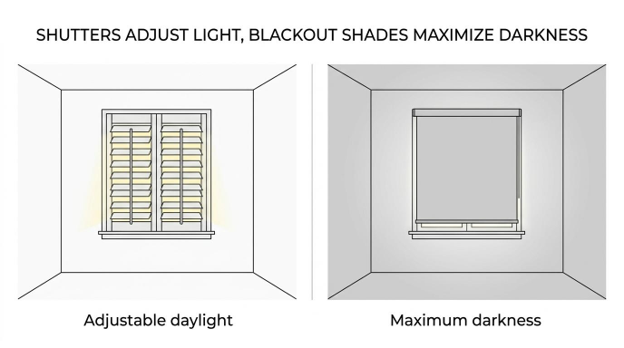
Blackout shades work differently. They use a continuous panel of opaque material that covers the window opening. When lowered, they block far more visible light than most other interior window treatments. When raised, they expose the glass again.
That makes shutters better for fine-tuning, while blackout shades are better for decisive light blocking.
Are Plantation Shutters Better Than Blackout Blinds?
Plantation shutters are better for adjustable light, flexible privacy, durability, and a built-in architectural look. Blackout shades are better when maximum darkness is the priority. The stronger choice depends on the room — shutters often suit living spaces and offices, while blackout shades usually suit bedrooms, nurseries, and media rooms.
“Better” also depends on the job you need the treatment to do.
If you want to soften glare at 2 p.m., keep privacy from the street, and still hold onto some daylight, shutters usually feel more useful hour by hour. However, if you want to make a bedroom dark enough for a light-sensitive sleeper at sunrise, blackout shades usually make more sense.
Which Option Provides Better Privacy?
Daytime Privacy
Daytime privacy is where shutters stand out.
Because the louvers tilt, shutters can direct light upward, while limiting direct sightlines into the room. In many layouts, that means you can still brighten the space without opening the window fully to an outside view. Configurations with divider rails or split tilt control can also make this even more practical by keeping the lower portion closed, while the upper portion admits light.
Blackout shades also offer excellent daytime privacy, but only when lowered. That is the tradeoff. Privacy improves, yet the view and much of the daylight disappear at the same time. If the goal is privacy without making the room feel closed off, shutters tend to feel more balanced.
Nighttime Privacy
At night, both can perform very well when fitted correctly.
A blackout shade made with opaque material provides strong privacy, as long as it fully covers the opening. Shutters also provide excellent nighttime privacy once the louvers are fully closed. The weak point in either system is fit. Poor measuring can leave gaps at the edges of a shade, while a shutter with looser closure or an awkward frame condition can allow light lines and limited visibility. Custom measuring matters more than many homeowners expect.
Do Plantation Shutters Make A Room Dark?
Yes, plantation shutters can make a room significantly darker, but they do not usually create the same near-total darkness as a properly fitted blackout shade.
Light can enter around shutter panel edges, between louvers, near hinges, or through small frame tolerances. The exact pattern changes with louver size, panel configuration, and how tightly the product fits the window frame. A good custom fit improves room darkening, yet shutters are still designed for adjustable control rather than full blackout performance.
For many bedrooms, that is enough. Plenty of homeowners want a darker room, not a cave. Shutters can work very well in those spaces, especially when the sleeper is not extremely sensitive to dawn light.
However, if the room is for a shift worker, a nursery, a child who wakes with early sunrise, or a dedicated media room, blackout shades usually provide a stronger result. Inside mount shades can look clean, though outside mount installation or side channels may reduce light gaps more effectively when darkness is the priority.
Which Option Blocks More Las Vegas Heat?
Heat control is more nuanced than darkness.
The U.S. Department of Energy notes that interior blinds and shades can reduce unwanted solar heat gain, and it also separates visible transmittance from solar heat gain. In plain terms, a treatment can reduce glare and visible light without being identical in thermal performance. In Las Vegas, that matters because west-facing and south-facing glass can stay punishing well into the afternoon.
Shutters create a structured barrier between the glass and the room. When closed or tightly angled, they reduce direct sun, cut glare, and help moderate how much radiant heat reaches inside.
Blackout shades also stop visible sunlight effectively, but heat performance varies more by fabric type and construction. A blackout roller shade may do an excellent job with light blocking, while a blackout cellular shade may offer stronger insulation because of its air-pocket design.
A good rule of thumb works well here.
- Best for adjustable heat management: Plantation shutters
- Best for eliminating visible sunlight: Blackout shades
- Best fabric option when insulation matters: Blackout cellular shades
- Best choice for a west-facing room: The one that fits tightly and stays closed during peak sun
Which Option Gives Better Light Control?
Light blocking and light control are not the same thing.
Blackout shades are better at blocking light. Plantation shutters are better at controlling light.
That difference becomes obvious in everyday rooms. Shutters let you redirect daylight, soften glare on screens, and keep a space bright without exposing everything to direct sun. You can also make small adjustments throughout the day rather than choosing between fully open and fully covered.
Blackout shades give you a stronger darkening effect, but they are less flexible once lowered. Partially raising a shade can create a bright opening on one part of the glass rather than a gentle adjustment across the whole window. Motorization helps with convenience, especially in bedrooms and media rooms, but it does not change the basic on-or-off nature of the light control.
Which Is Better For Bedrooms And Sleeping?
For sleep, blackout shades usually have an edge.
Early morning light in Las Vegas can be intense, and bedrooms with east exposure brighten fast. West-facing bedrooms face a different problem — they often stay brighter and warmer into the evening. In both cases, a blackout shade is usually the better answer when darkness is the top concern.
That is especially true for shift workers, nurseries, and anyone who wakes easily with small light leaks. Cellular blackout shades are often a strong fit for bedrooms because they combine room darkening with added insulation. Roller blackout shades also work well when a clean, simple appearance is the goal.
Plantation shutters still deserve a place in bedroom planning. They offer strong privacy, an elegant built-in look, and better daytime flexibility than blackout shades. If the room is used as a bedroom plus a reading room, dressing room, or retreat during the day, shutters may feel more comfortable to live with. A custom fit is essential either way, and this is also where reviewing bedroom shutters can help narrow the choice.
Which Is Better For Living Rooms, Home Offices, And Media Rooms?
Living Rooms
Living rooms are often strongest with plantation shutters because these spaces change constantly throughout the day. Morning light, TV glare, street-facing privacy, and evening ambiance all benefit from adjustable louvers.
Home Offices
Home offices often reward precise glare control. Shutters can soften sunlight on monitors without making the room feel closed. If the office doubles as a presentation room or gets severe direct sun, blackout shades may still be useful, though some homeowners may prefer lighter-filtering shade options for screen work.
Media Rooms
Media rooms usually favor blackout shades. If the goal is the darkest possible viewing environment, shutters are rarely the top performer. They can still work in a multipurpose room where complete darkness matters only some of the time.
Nurseries
Nurseries usually benefit from blackout shades because daytime naps depend on darker conditions. Cordless and motorized options can also make daily operation simpler and safer.
How Do Style And Appearance Compare?
Style is less about right or wrong and more about what kind of room you want to create.
Plantation shutters bring structure. They look built in, permanent, and architectural. That works well in traditional homes, and includes Mediterranean interiors, desert contemporary spaces, ranch homes, and many clean modern rooms. They also suit homeowners who want the window treatment to feel like part of the home itself rather than an added fabric layer.
Blackout shades feel softer and quieter visually. They come in a wide range of textures, colors, and minimal profiles. When raised, many disappear almost entirely, which helps keep the window area visually open. That can be appealing in contemporary bedrooms or media rooms where restraint matters more than visible detail.
Which Is Easier To Clean And Maintain?
Maintenance depends on what kind of surface you prefer to live with.
Shutters are usually straightforward to wipe down, and hard surfaces are appealing in dusty climates. The tradeoff is that each louver collects dust, so cleaning involves more individual passes. Blackout shades often have a broader surface that can be dusted quickly, but fabric can be less forgiving if stained, and some operating systems may need service over time.
In busy family rooms, kitchens, and street-facing spaces, shutters often feel sturdier. In bedrooms and guest rooms, many homeowners are happy to trade a bit of fabric care for deeper darkness.
Can You Combine Plantation Shutters And Blackout Shades?
The answer is sometimes.
Layering can work when someone wants the architectural look of shutters, plus stronger nighttime darkness. That said, it is not necessary in every bedroom, and it can make the window look heavier. Window depth, mounting space, and the visual balance of the room all matter before combining products.
In some homes, a secondary drapery layer may look more natural than placing a blackout shade with shutters. A room-by-room plan usually leads to a cleaner result than trying to force one layered strategy everywhere.
Plantation Shutters Or Blackout Shades: How To Choose By Room
Most Las Vegas homes do not need the same answer in every room.
- Choose plantation shutters if you want adjustable daylight, privacy with a view, a hard surface that wipes clean, and a built-in look for rooms used all day.
- Choose blackout shades if maximum darkness, naps, sleep quality, or screen viewing are the main priorities.
- Choose based on exposure (east-facing rooms often need better morning darkening, while west-facing rooms need stronger late-day sun control).
- Choose based on use (bedrooms and guest rooms usually benefit from deeper room darkening, while living spaces usually benefit from flexibility).
A practical room-by-room layout often looks like this:
- Living rooms and kitchens
- Street-facing rooms
- Home offices
- Bedrooms and guest rooms
- Nurseries
- Media rooms
In many homes, the first three favor shutters, while the last three favor blackout shades.
Compare Window Treatments In Your Las Vegas Home
The strongest plan is often a mixed one. Use shutters where daylight, privacy, and daily flexibility matter most. Use blackout shades where sleep or screen darkness matters more than view.
An in-home measurement also makes the choice clearer because fit changes everything, from side gaps and louvers to glare control and room darkening. In a climate this bright and this hot, matching each room to the right treatment usually works better than trying to make one product solve every problem.